
BUILDING REAL-TIME NATURAL ENVIRONMENTS — PART 01
Identifying the elements
Building a reusable asset library from a single tree species.
Building a convincing forest is not only about creating the trees. During capture, we break each species down into individual elements that can be reused throughout the wider environment.
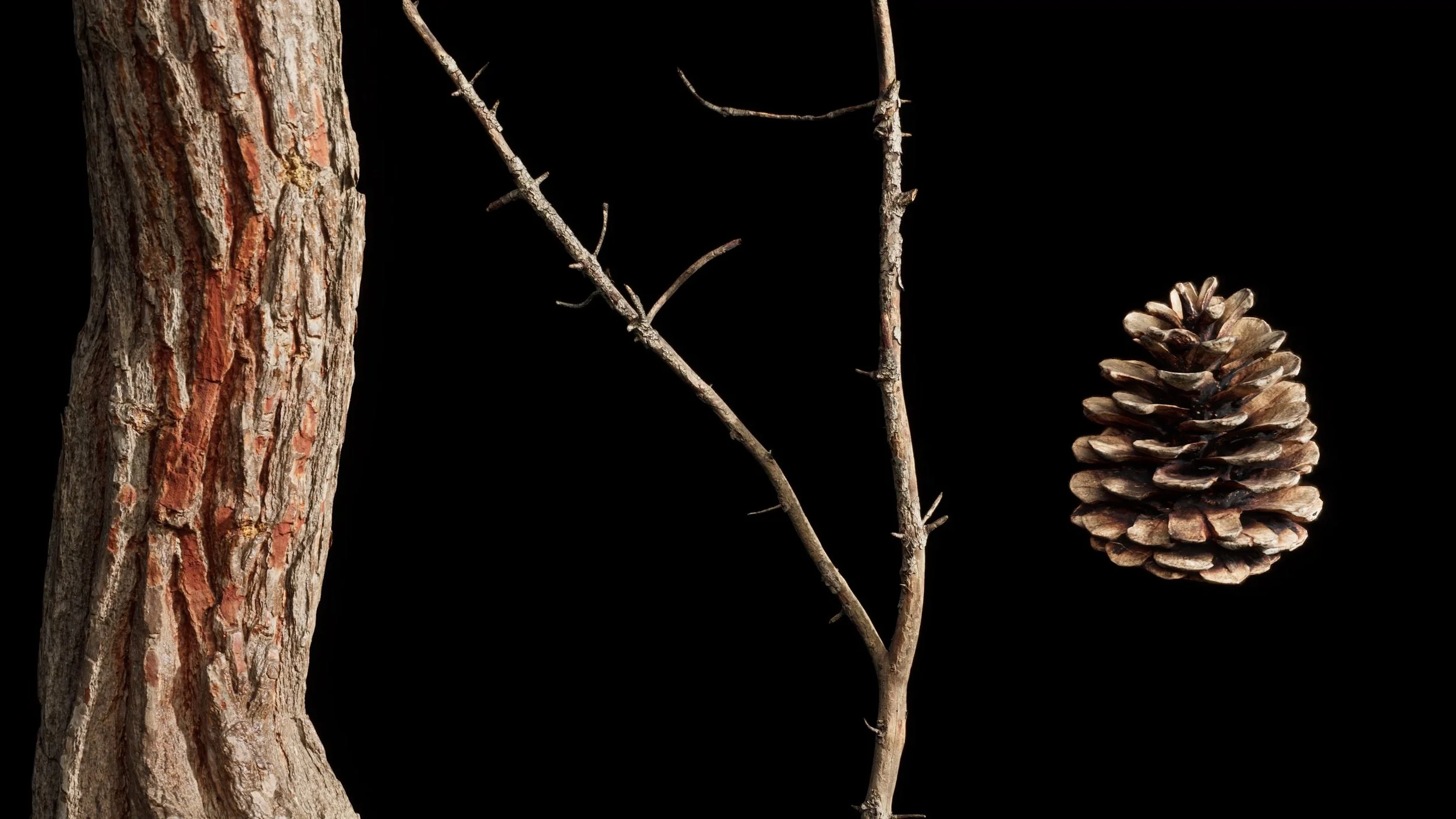
For the Aleppo pine, this includes:
trunks/branches
cones/needles
deadwood/surfaces
Some of these elements form the tree itself, while others become forest-floor scatter and used to integrate assemblies.
Species: Pinus halepensis
Trunks
A single trunk cannot provide enough variation across an entire forest. However, creating every tree as a unique asset is equally impractical. The goal is therefore to identify which structural elements can be reused without making that reuse visible.
Generic trunks are good to avoid obvious repetition, but a lack of variation can result in a generic scene.
Secondary elements
Branches, cones, needles and loose bark form the smaller parts of the library. Some are used to build the trees, while others also become ground scatter or details around neighbouring assets.
In general, we would focus on using these elements in places that will be more visible to the camera, while relying on tileables to do the heavy lifting in less important areas.
Forest-floor scatter
Besides being used to build the tree, from an environment creation POV many of these elements are the foundation of a forest, and will be used as ground scatter.
That is also why we make sure to capture closed meshes, as we often utilize simulation techniques to create a volumetric and layered forest base.
Environmental integration
It’s generally best practice to remove small, lose objects from the subject you are scanning, as this helps to get a cleaner output.
As a result, assets do not feel integrated with the environment.
We use the scatter elements to help re-introduce the details in a cleaner, more flexible and efficient way.
We will speak more on this in a separate post.
Simulated assemblies turn clean scans into believable parts of an environment.
Extracting surfaces
Finding the right surface with the right features to match with the trunk scans is important. The goal is to be able to blend the unique trunks and the surface tileables not only seamlessly, but with relatively matching features.
Sometimes this can be tricky, and you may need multiple if you’re being thorough.

Final thoughts
Breaking a tree species down into reusable elements gives us more flexibility when building the wider environment. Trunks and branches provide the structure, matching bark surfaces help connect them, and smaller elements carry through into ground scatter and assemblies.
The useful decisions start during capture: which shapes need to be unique, which can be reused, and where individual details will be visible to the camera. Planning around those uses helps us build a library that supports several parts of the environment.
The aim is to preserve the character of the species while giving us enough variation to build a convincing forest.
Plan each capture around how its elements can be reused throughout the environment.